“You will know them by their fruit.” Matthew 7:16
Prophecy has been a part of Jewish culture for over 3000 years, ever since the Lord God of Creation imparted divine breath to bring Adam to life. Breath, of course, is the same word as “spirit” in Hebrew, which hints that humanity was formed from the beginning to receive spiritual intimations. From that time on, God has continued to relate to humanity by conveying prophetic insights to help people live in harmony with their Maker and each other. This Brief highlights how Biblical prophecy originated, shaped and continues to reshape our understanding of the Messiah.
Many ancient cultures relied on divination to interpret omens and portents, and various portentous predictions of future events are found worldwide. However, the number, specificity and global breadth of prophecies found in the Bible is a major distinction of the Judeo-Christian worldview. Twenty-seven percent of all Bible verses are said to be prophetic in nature, totaling 1,817 prophecies.[1] Prophecy is an ancient and integral part of the unfolding story of the Messiah.
Recognized prophets in Judaism were called navi[2], which means “fruit of the lips,” because they spoke from divine inspiration. Sometimes God spoke through them in words, sometimes through visions, or divinely inspired symbolic actions. Prophets’ primary role was less to predict the future than to convey God’s purposes for their generation. In Old Testament times, thousands of local prophets were found in Israel[3], which shows the extent to which God desires to make divine direction available to everyday people, not just leaders and specialized priests.
Only 55 prophets’ words were considered divinely ordained for future generations and so were included in the Biblical canon. Some important prophecies were also preserved in ancient extra-Biblical sources, such as the Dead Sea Scrolls, which we’ll look at shortly. Altogether, Israel’s scriptural prophetic legacy has greatly encouraged Israel’s descendants as God intended ever since they were driven out of the Holy Land by the Romans in the first and second centuries AD.
Christians conclude over half of all predictive Biblical prophecies about future events have been fulfilled, which strengthens faith that the remaining prophecies will also be fulfilled. The challenge isn’t a lack of prophecies. The challenge is interpreting them correctly. In our time God is restoring important ancient insights that clarify and encourage Bible believers everywhere.
The Messiah in Prophecy
Surprisingly, the formal title “Messiah” is not used in the Old Testament as a direct title of a heroic deliverer except in Daniel, which uses the word that way twice. Yet it is easy to find online lists of 20, 100 or even 300 or more prophecies in the Old Testament fulfilled by Jesus. In other words, those ancient prophecies described Jesus’s life, teachings and actions without using the title “Messiah.” The accuracy of those prophecies could only be confirmed after Jesus did what He did on earth.
Jesus frequently quoted Old Testament prophecies and told His disciples what was going to happen to Him, yet many didn’t understand His messianic role until after He rose from the dead. People certainly had opinions about Him. Once He asked three of His closest disciples “Who do people say that I am?” They replied: “Some say John the Baptist; others say Elijah; and still others, Jeremiah, or one of the prophets.” Peter alone blurted: “You are the Christ, the Son of the living God.” (Matthew 16:13-20.) Jesus said: “this was not revealed to you by flesh and blood, but by My Father in heaven.” But He instructed His disciples not to tell others.
The disclosure of Jesus as the Messiah was divinely directed until word of mouth could not be stopped. Even then, people were confused about what the long-expected Messiah was going to do. When Jesus miraculously fed 5,000 hungry people, some pursued Him afterward for more. He told them they sought him only “because you ate your fill of loaves” (John 6:26-27, ESV). They were convinced He was a powerful ruler who would conquer the Romans and bring prosperity. Jesus admonished them: “Do not work for the food that perishes, but for the food that endures to eternal life, which the Son of Man will give to you. For on Him God the Father has set his seal.”
A few were confident about His identity very early in His public ministry. Jesus’s forerunner, John the Baptist, knew. He declared: “This is He who was spoken about through the prophet Isaiah” (Matthew 3:3). One of John’s followers, Andrew, told his brother Simon Peter “We have found the Messiah” (John 1:41). Another of John’s followers, Philip, told Nathanel: “We have found the One Moses wrote about in the Law, the One the prophets foretold—Jesus of Nazareth, the son of Joseph” (John 1:45, italics added). Yet, when John the Baptist was later in prison, he sent some disciples to ask Jesus: “Are you the One who was to come, or should we look forsomeone else” (Luke 7:19). Jesus responded by reciting His miraculous works that confirmed Old Testament prophecies. Jesus’s messianic significance was simply not clear to most people until after the Cross.
The day after His resurrection, Jesus appeared in the midst of His disciples as they huddled in a closed room, anxious about the future. Everyone was startled. “Why are you troubled,” Jesus asked, “and why do doubts arise in your hearts? Look at My hands and My feet. It is I Myself. Touch Me and see—for a spirit does not have flesh and bones, as you see I have” (Luke 24:38-39). To further ease their concerns, Jesus opened their minds to understand the scriptures, saying: “These are the words I spoke to you while I was still with you: Everything must be fulfilled that is written about Me in the Law of Moses, the Prophets, and the Psalms” (Luke 24:44-45, italics added). The thought that Jesus was resurrected was at first beyond their comprehension—until Jesus explained it to them again, and again, and even then it remained a challenging mystery.
A Messiah King
In the Old Testament, knowledge of the Messiah was hidden in plain sight. Daniel once had a vision of God, who he called “the Ancient of Days,” who took a seat in Heaven, followed shortly by the appearance of a messiah-like ruler called the Son of Man:
I saw One like the Son of Man coming with the clouds of heaven. He approached the Ancient of Days and was led into His presence. And He was given dominion, glory, and kingship, that the people of every nation and language should serve Him. His dominion is an everlasting dominion that will not pass away, and His kingdom is one that will never be destroyed. Daniel 7:13-14, italics added
“Son of Man” was Jesus’ favorite term for Himself, used 82 times in the New Testament. Daniel’s vision anchored the idea that the Son of Man would rule over all the earth. His rule would be universal, everlasting and not limited to Israel. Every tribe and nation would serve him. The Son of Man would be anything but an ordinary human ruler. However, there’s no suggestion here of a Messiah who would suffer and die on a cross.
Two chapters later in the Book of Daniel, we find the only two direct mentions in the Old Testament of Messiah used as a formal title for a heroic deliverer of Israel. The mentions appear back to back, again referencing a kingly figure:
Know and understand this: from the issuance of the decree to restore and rebuild Jerusalem until the Messiah, the Prince [reigns], there will be seven weeks and sixty-two weeks. It will be rebuilt with streets and a trench, but in times of distress. Then after the sixty-two weeks, the Messiah will be cut off and will have nothing. (Daniel 9:25-26, italics added for emphasis)
In Hebrew it’s grammatically unclear whether these two mentions refer to a single anointed Prince or two individuals. Most Jews came to expect the arrival of a single Messiah King. Being “cut off” indicated he would die, yet there’s no indication Daniel’s Prince would suffer, die and rise again from the Dead. This lack of clarity has carried over in Judaism to modern times.
Jewish sources today reflect multiple interpretations of the Messiah, including whether he exists at all.[4] The Jewish Encyclopedia says,
“the descendant of David . . . is to free Israel from the power of the heathen world, kill its ruler and destroy his hosts, and set up his own kingdom of peace.”[5] Jeffrey Spitzer, of My Jewish Learning, says, “The Messiah will help usher in the redemption of the Jewish people…[as a] descendant of King David…a great warrior…skilled judge… [and] academic head.”[6] Other contemporary Jewish views have minimized or altogether rejected the belief in a literal, personal Messiah. They emphasize human responsibility and effort to make peace, “repair” the world (referred to as Tikkun Olam, long a motivational catalyst for Jewish philanthropy), and usher in a utopian era of civilization.
These discrepancies reveal a prophetic cloud of unknowing about the Messiah in Judaism, which led Reform Judaism to reject altogether the traditional Jewish hope for an heir of King David to appear in modern times. Today, many Jews believe there is no messiah, just a messianic age.
The Suffering Messiah of Isaiah 53
Isaiah 53, written some 2,700 years ago, epitomizes a suffering Messiah but, again, does not use the word Mashiach. The first eight verses (Isaiah 53:1-8) of this passage depict someone called the “arm of the Lord” who would undergo great suffering, specifically:
v.3 – He was despised and rejected by men, a man of sorrows, acquainted with grief… took on our infirmities and carried our sorrows… We considered him stricken by God, struck down and afflicted…
v. 5 – He was pierced for our transgressions…crushed for our iniquities…the punishment that brought us peace was upon Him…
v. 6 – The LORD has laid upon him the iniquity of us all…
v. 7 – He was oppressed and afflicted… He was led like a lamb to the slaughter…
v. 8 – By oppression and judgment he was taken away… He was cut off from the land of the living…stricken for the transgression of [God’s] people.
Whoever Isaiah 53 describes would suffer greatly for Israel’s sins and die, cut off from the land of the living. Yet the prophet did not explicitly call the person the Messiah. His identity had to be pieced together from this and other descriptions offered by multiple prophets over time which together form the mosaic of what would come to be called “the Suffering Messiah.”
(Mis-) Understanding Isaiah 53
Isaiah 53 appears among four “Servant Songs” in Isaiah (42:1-9; 49:1-13; 50:4-11; and 52:13-53:12). Some Jews interpret all four of these passages to refer to the entire nation of Israel as the servant, not an individual. However, the New Testament reveals that the eight verses quoted above perfectly describe Jesus. It’s noteworthy that the Christian view finds support among very early Jewish interpreters who saw Isaiah 53 as pertaining to a single person, not all Israel. Here’s a summary of such Jewish views[7]:
Our ancient commentators with one accord noted that the context [of Isaiah 53] clearly speaks of God’s Anointed One, the Messiah. The Aramaic translation ascribed to Rabbi Jonathan ben Uzziel, a disciple of Hillel who lived early in the second century C.E., begins with the simple and worthy words which affirm Isaiah is talking about an individual:
“Behold my servant Messiah shall prosper; he shall be high, and increase, and be exceeding strong: as the house of Israel looked to him through many days, because their countenance was darkened [oppressed] among the peoples, and their complexion beyond the sons of men.” (Targum Jonathan on Isaiah 53).[8]
The same interpretation is found in the Babylonian Talmud, which emphasizes the Messiah will suffer on behalf of others. There, the rabbis wrote “His name is ‘the leper scholar,’ as it is written, ‘Surely he hath borne our griefs, and carried our sorrows: yet we did esteem him a leper, smitten of God, and afflicted’” (Sanhedrin 98b). A similar conclusion appears in the Midrash Rabbah commentary to Ruth 2:14.
A starkly different view was popularized by the influential teacher Rashi (Rabbi Shlomo Itzchaki), who lived in France a thousand years after Jesus (1040-1105 CE). Rashi famously concluded the suffering servant of Isaiah 53 referred to the collective nation of Israel rather than an individual person. Scholars attribute Rashi’s view to two main factors. Historically, this position is traceable to the Pharisees who condemned Jesus to death, upon whom Jesus foretold would come “all the righteous blood that has been shed on earth” (Matthew 23:35). Jesus was saying the entire nation of Israel would suffer greatly for rejecting the Lord’s true righteous servants. Secondly, Rashi wrote during the first Crusade in 1096, when European armies enroute to free the Holy Land from Muslim rule burned Jewish villages and murdered Jews while passing through the Rhineland. Rashi likely saw that as an expression of collective suffering aligned with the description in Isaiah 53.[9]
Some rabbis agreed with Rashi, but others did not. Rabbis who disagreed noted the text of Isaiah 53 is grammatically in the singular.[10] Some also saw a problem with verse 8 says the suffering servant “had done no violence, nor was any deceit in his mouth.” Israel was never totally without violence or sinless, as many Old Testament passages attest. Therefore, Isaiah 53 cannot refer to the entire nation of Israel.
In my view Rashi represents a valid perspective that Israel is, in fact, a Suffering Servant of God. Not because Jesus isn’t the true Suffering Servant Messiah, the Passover Lamb who takes away the sin of the world. Rather, because Israel is the apple of God’s eye (Zechariah 2:8) destined, it seems, from the beginning to collectively and profoundly suffer as an archetype for the travail through which all nations must pass until they recognize their ultimate Messianic Deliverer. The New Testament concludes, “every eye will see [Jesus]—even those who pierced Him. And all the tribes of the earth will mourn because of Him. So shall it be! Amen” (Revelations 1:7, italics added).
The Eye-Opening Dead Sea Scrolls
The dispute between Christians and medieval rabbis like Rashi (and many modern rabbis) has very deep roots. Important new light was shed on this age-old controversy by the Dead Sea Scrolls (DSS) which were discovered providentially between 1947 and 1956, coinciding with the birth of Israel as a modern nation. Written by a Jewish religious sect called the Essenes during the 200-year period preceding the birth of Christ, the scrolls help fill the gap between the last Old Testament prophet, Malachi, and the arrival of Christ, an era long considered prophetically silent. Thousands of scroll fragments and a single intact scroll have been found from every book of the Old Testament except Esther. The Essene texts are over 1,000 years older than the Masoretic Text (c. 1000 AD), which is the source text for the modern Hebrew Bible.
The scrolls became available for study outside of Israel only in 1998, and were not available online until 2011. Internet access has inspired new research and a flood of insights into the history of the Essenes, their beliefs, and their prophetic outlook. At a minimum, the fragments confirm that the Bible we read today is virtually the same as what has been found in many of the ancient scrolls.
Remarkably, the lone intact book found among the scrolls was the “Great Isaiah Scroll” (1QIsa-a, dated to 150-100 BC). Over 24 feet long, it contains all 66 chapters of the book of Isaiah. Additional fragments of Isaiah 53 were also found, including one known as the “Self-Glorification Hymn” (4Q471b). In it an unnamed author applies portions of Isaiah 52-53 to himself, and writes in the first person identifying himself as seated in heaven with God. The scroll is a hymn portions of which also appear in four other scroll fragments. Scholars debate what this means, but it establishes that the Essenes of Qumran engaged in deep spiritual worship and the priestly speaker in the Self-Glorification Hymn leads them in an experience of heavenly glorification among the angels. The speaker also asks “who is like me among the gods?” This leads to the conclusion the speaker is a forerunner who can bring others into communion with the Divine, a type of Christ, the Messiah. [11]
The mystical disposition of the Essenes seen in this and other scrolls has been characterized by Dr. Ken Johnson this way:
The community in Qumran called themselves ’Yahad ’…a contraction of two Hebrew words, Yah the name of God, and ehad [echad], meaning “one”…. So, the name “Yahad” literally means unity in the Spirit of God. They believed they were led directly by the Holy Spirit, so they truly were “one in the Spirit” [prefiguring the centrality of Holy Spirit in Jesus’s teaching and ministry].
Their major center of ritual that we call Qumran, they called New Damascus. Their name “Damascus” is made up of dam, meaning blood, and masheq, meaning “heir” or “stronghold.” New Damascus was the stronghold of the ancient ways and those loyal to the true blood heir, the coming Messiah. Incidentally, the term “Melchizedek” translates out to mean King (Melech) of Righteousness (Zedeq) but it could also be translated as the “King of the Zadok priests!”[12] (emphasis added)
Who Were the Essenes?
The Essenes’ customs and beliefs highlighted in the scrolls were described in ancient writings from Josephus, Philo of Alexandria, Pliny, Hippolytusand others. According to those sources, as many as 4,000 Essenes lived during Jesus’s time scattered in small communities throughout Judea, including near the Sea of Galilee, and on Mt. Zion in Jerusalem.[13] They were not only reclusive desert dwellers and not all Essene communities shared the same beliefs. For a time some Essenes were active in 2nd Temple religious affairs. Evidence strongly suggests John the Baptist, Jesus and some of Jesus’s disciples had ties to the Essenes, or at least knew of their writings. It also seems likely the Apostle Paul spent time with them, perhaps during his 3-year retreat after encountering the Lord. These relationships are discussed in Dr. Ken Johnson’s book, The Ancient Order of Melchizedek.
Following the destruction of the 2nd Temple in 70 AD, the Essenes disappeared from history. Scholars don’t know why or where they went, but many Essenes may have become followers of Christ due to the strong parallels between their teachings and His. Evidence shows the Essenes were looking for two Messiahs, one who would suffer and die, and one who would become King, but there appeared to be uncertainty in how that would unfold. When John the Baptist was imprisoned by Herod Antipas, John sent his disciples to ask if Jesus was the one they should expect, or whether they should expect someone else. Jesus mentioned healings and deliverances, but He didn’t talk about defeating Rome. Once again, His true role only became clear after His death and resurrection.
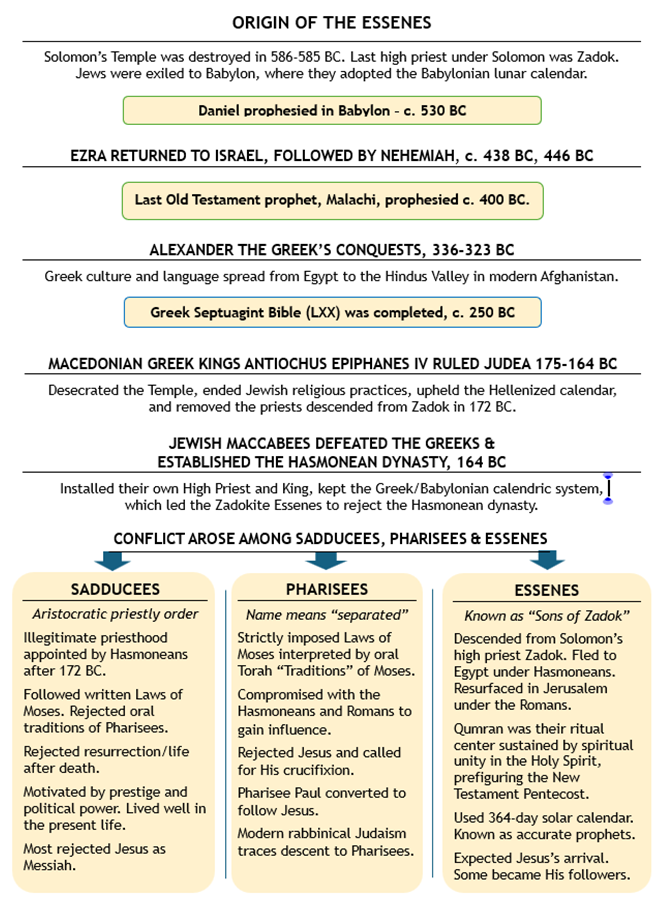
The preceding chart summarizes key historical details related to the Essenes. They descended from Zadok, the last high priest appointed by Solomon, whose temple was destroyed in 586-585 BC. Fast forward to Alexander the Great’s conquests and early death in 323 BC. That led to establishing a Greek “Seleucid Empire” in the eastern Mediterranean region, including Judea. In 168 BC, the Seleucid king Antiochus Epiphanes IV famously desecrated the Temple in Jerusalem, banned Jewish religious practices, and upheld the lunar calendar used throughout Alexander’s former empire in place of Israel’s ancient Temple calendar.
The Greek’s abominations fulfilled prophecies in Daniel, and led to a revolt by Judas Maccabeus, who restored Jewish independence in 164 BC. The Jewish festival Hanukkah celebrates that victory. However, conflict arose among three influential religious groups vying for power, the Sadducees, Pharisees and Essenes. The Sadducees’ name means “Zadok,” but not the Zadok who was high priest under Solomon.[14] Instead, the Hasmoneans appointed a new line of Sadducee priests, and many true Zadokites eventually had to flea to escape persecution from both Sadducees and Pharisees.
The Sadducees rejected the resurrection of the dead, which prevented them later from acknowledging Jesus’s resurrection, which threatened their power. They also rejected the oral traditions of the Pharisees, whose scriptural interpretations led them to expect a king, but not a suffering Messiah. After conquering Judea in 63 BC, the Romans imposed tenuous religious tolerance on the Temple that enabled Essenes to resurface in the religious affairs of Israel. Others stayed out of the public eye in small communities, including the reclusive community at Qumran.
The Apostle Paul would one day write: “what I received I passed on to you as of first importance: that Christ died for our sins according to the Scriptures, that He was buried, that He was raised on the third day according to the Scriptures” (1 Corinthians 5:3-4, italics added). Neither the Pharisees nor the Sadducees interpreted Jewish scriptures that way. Paul’s letter clearly reflects tenets held by the Essenes. Beyond this, other Essene scroll fragments provide farther-reaching insights into the background and role of the Messiah that predate Christ.[15]
The Essene Calendar
A major problem for the Essenes was the Helenized 360-day lunar calendar Israel adopted during exile in Babylon and upheld by the Seleucid rulers. This accommodation aligned Israel with dates used regionally in commerce and taxation, similar to modern fiscal calendars.[16] To gain influence, the Sadducees and Pharisees accepted the Hellenized calendar, a version of which most modern Jews still follow today. The Essene’s 364-day solar calendar was derived in part from ancient sources in the Book of Jubilees and the Book of Enoch, fragments of which were found at Qumran. The Book of Jubilees at Qumran dates to 160-150 BC, and was considered a divine revelation given to Moses. The Book of Enoch (1 Enoch) includes multiple subtexts written from the 3rd century BC to 1st century AD. Neither book is found in Protestant or Roman Catholic Bibles, but as an aside it’s notable that both books are preserved in the modern Ethiopian Bible. Western Christianity shaped its narrower canon around doctrines that emerged from church councils in the 4th through 8th centuries, while the Ethiopian Church developed a broader canon apart from Western influences.[17]
The Essene calendar is dated to the Biblical creation of the world (Anno Mundi, or AM). Thisoften seems arbitrary and mythological to modern thinking, but when the Biblical creation story is understood as marking a unique moment in time when humanity emerged as we know it—made in the image of God with a special capacity to relate personally to the Divine Nature (2 Peter 1:4)—then AM dating is profoundly revelatory and meaningful.
The Essene calendar began on the same day every spring, and consisted of twelve 30-day months, plus four extra days inserted at the start of every season, one for each solstice and equinox. Adding the extra days allowed the Biblical festivals to land on the same weekday every year, and none occurred on a shabbat. For example, the new year always begins on the spring equinox, which by definition is the first day of the first month, and Passover always begins 14 days later at sunset.[18]
The Essene 364-day year divides evenly by seven. Every seven years, debts were released and fields were allowed to rest. (See Deuteronomy 15:1-2.) Every 49 years were followed by an added Jubilee year, when slaves were released and property sold during the previous 49 years was returned to its original owner, per Leviticus 25:8-12. These calendric timeouts reaffirmed Israels’ total dependence on God. The Jubilee years also prophetically anticipated the redemptive work of the Suffering Messiah, who came to restore everyone’s original spiritual inheritance intended by God. Rabbinic tradition maintains that Jubilee years were only valid when all twelve tribes lived in Israel.[19]
The Essene calendar eliminated human intervention for determining when the festivals occurred and improved prophetic accuracy. (The Roman historian Josephus wrote that the Essenes “rarely, if ever fail in their predictions.”) The Essene calendar fascinates many people today because it predicts that the New Millennium when Christ will re-appear begins in 2075 AD. Here’s an overview:
The calendar lays out four “Ages” including three consisting of 2,000 years each, plus a final Millennial Age prophesied to last 1,000 years. These ages total 7,000 years beginning with Creation in the AM calendar, as follows:
(1) Age of Chaos, 2,000 years from Adam to the Flood to the call of Abraham to follow God.
(2) Age of Torah/Law, 2,000 years that culminated in 75 AD with destruction of the Temple, the end of Jewish Temple sacrifices, and exile of most Jews from Judea.[20]
(3) Age of Grace/Church Age, 2,000 years ending in 2075. The last 50-year Jubilee period before the Millennial reign of Messiah began in 2025.
(4) Millennial Age, 2075, when Messiah returns to reign from Jerusalem for a thousand years.
Transitions between these Ages overlap by 50-100 years instead of rolling over in a single momentous event or year. For example, the Age of Grace inaugurated by Jesus did not spread widely until after the Temple was destroyed in 70 AD, approximately 70 years after his birth. This is important because Jesus said no one except the Father knows the specific day or hour when He will return as the Messiah King (Matthew 24:26). On the other hand, when the Pharisees and Sadducees once demanded Jesus show them a sign, He responded:
“When evening comes, you say, ‘The weather will be fair, for the sky is red,’ and in the morning, ‘Today it will be stormy, for the sky is red and overcast.’ You know how to interpret the appearance of the sky, but not the signs of the times.” Matthew 16:2, also Luke 12:54-56, emphasis added.
Jesus was saying they ought to know enough to perceive and respond to what God is doing without getting caught up looking for specific signs and dates. Regarding such events, Jesus told His disciples: “Be always on the watch, and pray that you may be able to escape all that is about to happen, and that you may be able to stand before the Son of Man” (Luke 21:34-36, italics added).
The Essene Prophetic Record
Important Biblical events are correlated with meaningful moments in the Essene Anno Mundi calendar, which lends credibility to the calendar’s continuing accuracy and reliability. One example is the timing of Israel’s arrival at Mt. Sinai during the Exodus, which the Essene calendar indicated occurred in the year 2,488 AM, which converts to 1273-72 BC. Many academics insist the Exodus occurred later than this—or never occurred at all! The Essene reckoning places it in an earlier timeframe confirmed by recent archaeological evidence.[21]
Another event highlighted in the Essene prophetic record relates to King Herod and Jesus’s birth. A man known as Menahem the Essene was a Jewish sage renowned as the most learned member of the Sanhedrin who served with Hillel the Elder, head of the Sanhedrin from 30 BC to 10 AD. From this we know some Essenes held high positions of religious authority when Jesus was born. Menahem was also known for his prophetic ability. Josephus recounts that Menahem prophesied over the young Herod that he would become king even thoughhewas ineligible because his Edomite ancestors were foreign converts to Judaism. When Herod did become king, he summoned Menahem to inquire how long his reign would last. Menahem answered “at least 30 years.” Herod was satisfied with his answer and rewarded the prophet. Near the end of the 30 years, visiting Magi informed Herod a new king had been born in Bethlehem. In order to cut off any rival who might end his dynasty, Herod ordered the death of all male infants in Bethlehem, as recorded in Matthew’s Gospel.
The Essene Prophecy of the First Coming of Messiah
Perhaps the most notable Essene prophecy pertained to the first coming of Messiah. Scroll fragments labeled the Melchizedek Document (11Q Melchizedek) hold a treasure trove of remarkable Messianic information, including when the Messiah would arrive first. The fragments describe a time when “captives…whose teachers have been hidden and kept secret” will be set free as part of their “inheritance of Melchizedek.” This was to occur in the “first week of the jubilee which follows the nine jubilees” and the day of atonement would occur at “the end of the tenth Jubilee.” Document 11Q Melchizedek 2:2-10 describes this as “the year of grace of Melchizedek and his armies,” and also depicts a “nation of the holy ones of God…as written about him in the songs of David” [Psalm 82:1-2].[22]
This prediction has been calculated to equate to AD 25-32, corresponding to Jesus’s years of public ministry, crucifixion and resurrection.[23] Another fragment, Messianic Apocalypse (4Q521) says the Messiah would heal the sick, raise the dead, and proclaim liberty, as found in Isaiah 61. Jesus expressly applied this text to Himself at the beginning of His public ministry (Luke 4:18). It’s also the response He gave to John the Baptist’s disciples who came asking Jesus if He was the one they were expecting or whether they should keep looking for another (Matthew 11:3, Luke 7:19-20).
Melchizedek and the Essenes
One of the great puzzles of the entire Bible is the mystery of Melchizedek, who is first referenced in Genesis 14:18, when Abraham offered him a tithe of the spoils of the only war Abraham ever fought. King David also referred to Melchizedek in Psalm 110:4, which declares the one appointed by God to rule the nations will be “a priest forever, in the order of Melchizedek.” The New Testament Book of Hebrews speaks about Jesus in the context of Melchizedek multiple times (Hebrews 5:6, 6:20, 7:1, and 7:11), but these references leave a lot to the imagination that the Essene documents help clarify.
“Melchizedek” combines the Hebrew words for “king” and “righteousness,” but can also be translated king of the Zadok priesthood because Zadok is derived from the same Hebrew root as righteousness. Fragment 11Q Melchizedek reveals the Messiah is a Melchizedekian priest rather than a Levitical priest descended from Aaron. Moreover, Melchizedek was not a single individual but an order of priests. This view is confirmed in Hebrews 6:20, which says Jesus became “a high priest forever after the order of Melchizedek,” like Psalm 110.
In contrast, the Talmud, based on the oral traditions of the rabbis (originally from the pharisees), does not recognize an “order” of Melchizedek, only the appearance of a single Melchizedekian king of righteousness, who rabbinical tradition says was Noah’s son Shem.[24]
According to the Essenes, there were many Melchizedekian priests, including ten from Adam to Jesus who combined the three offices of King, Priest and Prophet.[25] Jacob would proceed to give the kingly blessing to Judah (Genesis 49:10). Later, under Moses, the priesthood was given exclusively to the Levites (Exodus 28:1). Under Solomon, the priestly office was limited more specifically to the sons of Zadok, who were a branch of the Levites. Afterward, the high priest always came from the Zadokites (Essenes) until the reign of the Macedonian Greeks, who the Zadokites zealously opposed. This led to their persecution and even the murder of some priests because they rejected Greek efforts to change the Biblical order of the Temple.[26] As a result, many Essenes fled to Egypt, while others retreated to the wilderness of Qumran, where they took their priestly library. After the Romans gained power over Judea, the contentious Temple power struggles stabilized and some Essenes returned from Egypt. Qumran also became an annual pilgrimage destination for Essene adherents scattered throughout Israel to renew their covenant with God, as confirmed by recent archaeology.[27]
Another Essene document, the Community Rule, records that one of their order would fulfill Isaiah 40:3-5, which says “The voice of him that cries in the wilderness ‘Prepare the way of the LORD’” (Community Rule, col. 8). Matthew’s gospel applies this description to John the Baptist, which indicates John played some kind of role conforming to the Essene’s prophetic outlook. The writings of Hippolytus, the early church father, confirmed this.[28]
Jesus ultimately recombined the three Melchizedekian offices of king, priest and prophet, as detailed in the New Testament. Christ’s legacy asserts that all who are joined to Him in Spirit are made “kings and priests unto God” (Revelation 1:4-6). Peter wrote that Christ followers are “a royal priesthood, a holy nation, a people for God’s own possession, to proclaim the virtues of Him who called you out of darkness into His marvelous light” (1 Peter 2:9). These statements echo Essene prophetic views so closely it’s difficult to believe it’s by mere chance.
The topic of darkness and light in Essene writings merits further attention, but first I want to touch lightly on one other prophetic marvel treasured by the Essenes.
The Testimonies of the Patriarchs
A number of Essene scroll fragments refer to ancient extra-biblical texts attributed to the twelve sons of Jacob—collectively known as the “Testimonies of the Patriarchs.”[29] Because these texts were never accepted into the Biblical cannon, they are often ignored in traditional Christian circles. However, their discovery at Qumran in scroll fragments that predate Christ and include specific prophecies about the coming of Jesus makes them noteworthy in the Essene prophetic record. Modeled on the biblical tradition of last words, like the blessings of Jacob in Genesis 48 and Moses’s pre-death “Song” in Deuteronomy 33, the Testimonies of the Patriarchs convey moral and prophetic content, and often reference “the Last Days.”
The Testimonies address the work of the Messiah, the falling away from the ancient path by Pharisees and Sadducees, and the new covenant of Grace the Messiah would release. The Essenes valued them as reliable accounts of God’s covenant purposes for Israel. Below are highlights from specific scroll fragments found at Qumran, catalogued in Ken Johnson’s Ancient Order of Melchizedek:
- The Messiah will be the Son of God, God incarnate – Levi 4, Zebulun 9, Naphtali 8 and Benjamin 10.
- The Messiah would come (as “the Seed”) from the tribe of Judah – Judah 24.
- The Messiah will be born of a virgin – Enoch 62:5, Joseph 19, Nathan fragments.
- Levites would call to crucify the Messiah – Levi 4, 16; Aaron 4,6; Benjamin 9.
- The Messiah will die for our sins – Reuben 6, Joseph 18, Benjamin 3, (also, 11Q Melchizedek).
- The curtain of the Temple would be torn in two – Benjamin 9.
- Levi’s priesthood would end when Messiah came –Reuben 6, Levi 4, 5; Benjamin 9.
- The Messiah brings salvation – Levi 4, Benjamin 3.
- The Messiah will be resurrected and ascend to heaven – Levi 16, 18.
The New Testament establishes that all these prophecies were fulfilled through Jesus’s life and resurrection. The Essenes attributed the prophecies to their predecessors and faithfully transmitted them to later generations. The New Testament says “the testimony of Jesus is the spirit of prophecy” (Revelation 19:10), indicating that authentic prophecy is inseparable from the way of the Messiah, whether or not messianic prophecies ended up in the Bible.
Sons of Light Versus Sons of Darkness
Paul wrote to the Thessalonians, saying:
“…you are fully aware that the Day of the Lord will come like a thief in the night… But you, brothers, are not in the darkness so that this day should overtake you like a thief…For you are all sons of the light and sons of the day” 1 Thessalonians 5:2, 4-5, italics added
The Thessalonians were not Essenes. They were followers of Christ. Paul also wrote later to the Ephesians: “For you were once darkness, but now you are light in the Lord. Walk as children of light, for the fruit of the light consists in all goodness, righteousness, and truth” (Ephesians 5:8-9). Paul was repeating a theme prominent in Essene writings, who likened themselves to sons of light. For example, the Essene Community Rule (1QS), emphasizes they were to live in “holiness, separation from impurity, and in ‘light’ rather than ‘darkness.’”[30]
A well-known scroll from Qumran called the War Scroll takes this imagery up a notch by describing a 49-yearlong end-times battle conducted in seven stages between righteous priests called the Sons of Light fighting against wicked, illegitimate priests called the sons of darkness. The battle between forces of light and darkness involves angels in heavenly realms fighting at the same time as human forces on earth. Eventually, the Sons of Light win the battle on earth, and the War Scroll says: “[The sons of jus]tice shall shine in all the edges of the earth, they shall go on illuminating, up to the end of all the periods of darkness” War Scroll 1:8a.[31] Scholars debate what past or future battle the scroll describes, but it definitely resonates with other biblical prophecies about the End of Days.
Jesus spoke about cataclysmic events in the last days, sometimes quoting Daniel.[32] In Matthew 13:41-43, Jesus says angels will be involved in heavenly realms while humans fight on earth. When the battle is won, “the righteous will shine like the sun in the kingdom of their Father,” a quote from Daniel 12:3, paralleled in the Essene War Scroll, 1:8a. In Matthew 24:15, Jesus references the “abomination of desolation” of Daniel 9. In Matthew 12:21, Jesus speaks of “great tribulation, unseen from the beginning of the world until now, and never to be seen again.” This is virtually a direct quote from the War Scroll 1:11b–12a.[33]
What to Make of All This?
Here’s the catch. Josh Peck, a certified prophecy watcher who has studied the War Scroll and other Essene prophecies in depth, concludes there is no way to know what specific battle is being described in the War Scroll. It can’t refer to the Roman War that led to destruction of the Temple in 70 AD, because that was not a victory for Israel. Does it describe the Battle of Armageddon (Revelation 16:16), the war of Gog and Magog (Ezekiel 38-39), or Zechariah 12-14? Or the End Times battle following the thousand year reign of Christ (Revelation 20:7-9)? Peck concludes the scroll might speak of a different war altogether, possibly in the past or in the future. There’s no way to know for sure. Once again we are thrown back into the prophetic cloud of unknowing where we can’t predict future things with certainty until after they occur. We can only know prophets by their actual fruit. “A good tree cannot bear bad fruit, nor can a bad tree bear good fruit” (Matthew 7:17).
What we have shown in this Brief is that many passages in the Old Testament describe a future Messiah without clearly saying He would come once as the Suffering Messiah and again as a King. Most Jews historically settled on expecting a single kingly Messiah who has yet to appear. We also know Jesus fulfilled many Old Testament descriptions of the Messiah who would suffer, as well as many extra-Biblical prophecies preserved by the Essenes who expected Him to return. On top of this, seven out of ten chapters in the New Testament mention Jesus’s return, roughly one out of every 25-30 verses. It would be unwise to ignore such compelling evidence about the return of the Messiah.
Amos 3:7 assures us that “the Sovereign LORD does nothing without revealing his plan to his servants the prophets.” The challenge, as I mentioned at the outset of this Messiah Brief, isn’t a lack of prophecies, but knowing how to interpret them. Paul cautioned Timothy to test all things and “only hold on to what is good” (1 Thessalonians 5:21)—which we can only know by their fruit.
The Dead Sea Scrolls definitely establish a different prophetic narrative than the world has heard the past 2,000 years based largely on the interpretations of rabbis who called for Jesus’s crucifixion. The Essenes provide us not only with a different perspective about the role of the pharisees, but also with a different narrative that leads explicitly and directly to Jesus’s identity as the Suffering Messiah who came, died, rose from the dead—and who will return again in the future. This seems like enough credible evidence to cause our Jewish friends to ponder their religious roots in a different light than they’re accustomed to hearing.[34]
The Scrolls also shed light on long-standing Christian doctrines that merit a second look at aspects of what Christians have been taught, especially in Western religious culture. We need to reexamine how the first Christians perceived Jesus and what the apostles actually proclaimed about Him.[35] To do this, it’s necessary to take another look at the Messiah who set the stars in place.
[1] J. Barton Payne, The Encyclopedia of Biblical Prophecy, Baker Pub. Group, 1980, pp. 674-675. The total includes 1,239 Old Testament and 578 New Testament prophecies. Christians believe the entire Bible is prophetic because it all points to the Revelation of Jesus Christ, as culminated in the Book of Revelation. See: How much of the Bible is prophecy? | GotQuestions.org
[2] Alternately: “nabi,” from the root, nun-vet, denoting hollowness or openness—the ability to receive divine knowledge via the Holy Spirit. Deuteronomy 18:18 identifies the scriptural basis of navi:”I will put My words in [the prophet’s] mouth, and he shall speak unto them all that I shall command him.” Eleven Old Testament prophets mentioned in the Bible were women.
[3] Prophets and Prophecy – Judaism 101 (JewFAQ). Estimates indicate the number of prophets in Israel over time totaled at least 44,000 (https://www.gotquestions.org/Israelites-exodus.html). Divine prophecy is held by most Jews to have ceased with the destruction of the Temple in 70 CE. However, fresh prophetic revelations are found among Jews down to modern times. A recent Orthodox Jewish book on prophecy is: Prophecies for the Era of Muslim Terror: A Torah Perspective on World Events, by Rabbi Menachem Kohen,Lambda Publishers, 2007. Pentecostal and charismatic Christians embrace fresh prophetic manifestations of the Holy Spirit which are potentially available now to all followers of Jesus.
[4] Adapted from “Jewish Views of the Messiah,” https://jewsforjesus.org/jewish-resources/messianic-prophecy.
[5] Ibid., citing Joseph Jacobs and Moses Buttenweiser, “Messiah,” Jewish Encyclopedia (Kopelman Foundation, 1906), Article. 10729.
[6] Multiple scriptures speak of a Messiah who will descend from King David. See 2 Samuel 7, Isaiah 11:1: Jeremiah 23:5-6, etc.. At least 150 families today (some say hundreds more) trace their descent back to King David, suggesting a literal descendent of David could still be born to lead modern Israel.
[7] See Efraim Goldstein, April 20, 2018, https://jewsforjesus.org/learn/whos-the-subject-of-isaiah-53.
[8] Frydland, Rachmiel, ISSUES: A Messianic Jewish Perspective, Vol. 2:5, p. 2
[9] Here are two resources for rabbinical views: (1) important pre-Christian Jewish prophecies that anticipate Jesus as the suffering Messiah: https://jewsforjesus.org/jewish-resources/messianic-prophecy. (2) a modern rabbinical view that vigorously defends the Servant of Isaiah 53 as all Israel rather than a single Messiah: https://www.qumran.org/js/texts/jes53.php.
[10] Efraim Goldstein, Op. cit., saysMaimonides [1138-2304 CE], who wrote the Thirteen Principles of Jewish Faith, disagreed with Rashi. The 12th Principle of Maimonides is: “The Messiah [singular] will come, and the faithful await his arrival every day.”
[11] Text of fragments of The Self-Glorification Hymn exalt the unmatchable uniqueness of the speaker, as seen here: https://saintshamoun.com/index.php/2025/11/02/pre-christian-exegesis-of-isaiah-5213-5312/. A scholarly analysis by Joseph Angel, the Jewish Theological Seminary, appears here: (26) The Liturgical-Eschatological Priest of the Self-Glorification Hymn
[12] Dr. Ken Johnson, Ancient Order of Melchizedek, Kindle, p. 35. Philo said the Essenes “are anxious to keep their minds in a priestly state of holiness.” Traditional Judaism referred to Essenes as hasidim, the same term used for the modern Jewish mystical sect, the Hasidim. See: https://www.jewishencyclopedia.com/articles/5867-essenes.
[13] See “Jerusalem’s Essene Gateway,” http://www.centuryone.org/essene.html. The “Upper Room” was located in the Essene quarter of Jerusalem. Essenes in the Galilee are documented in: (26) The Essenes of Mount Arbel and Jerusalem: Origins, History and Influence. Mt. Arbel overlooks the north end of the Sea of Galilee, where Jesus often spoke and ministered.
[14] The Sadducees’ founder traces to the first half of the 3rd century BC, to a pupil of Antigonus of Sokho named Zadok. See: https://torahislight.org/zadok-priestly-order/. More details at: https://www.jewishencyclopedia.com/articles/12989-sadducees.
[15] Wikipedia has a useful summary of theories about the influence and relationship of the Essenes to Jesus and His followers. Two resources that reflect Christian faith-based views include Dr. Ken Johnson’s https://www.BibleFacts.org, and Josh Peck’s Forgotten Prophecies of the Dead Sea Scrolls, Parts I and II.
[16] For a detailed analysis of why Jews adopted the Babylonian/Greek calendric, see: Did Ezra Come to Jerusalem in 457 BC?
[17] See The Ethiopian Bible: A Broader and Older Canon That Challenges the Standard Narrative – World Insight Info. The Ethiopian Bible includes 81 books, compared to 73 in the Catholic Bible and 66 in the Protestant Bible.
[18] Genesis 1:14 says the sun and stars were made as signs to mark the seasons. Recall that Jewish “days” run from sunset to sunset.
[19] Rabbis base this view on Leviticus 25:10. Tribes in exile for multiple generations may lose their ability to trace property “ownership” back to the Holy Land. Land ownership in modern Israel involves complex rules; 86% is “publicly owned.”
[20] The first great exile was to Babylon in 586 BC. In 445-438 BC, more Jews remained in Babylon than returned with Ezra and Nehemiah. By the 1st century BC, some 5 million Jews lived outside of Judea (including many in Egypt), outnumbering Jews who lived in the Holy Land. The final great diaspora occurred after Rome defeated Simon bar Kochba in 136 AD.
[21] An excellent video updating the time of the Exodus is: https://www.patternsofevidence.com/exodus-film/. A detailed technical analysis is found here: https://biblearchaeology.org/images/Emilys/Recent-Research-on-the-Date-and-Setting-of-the-Exodus.pdf.
[22] Josh Peck, Forgotten Prophecies of the Dead Sea Scrolls: Unlocking the Final Jubilee of the Church Age, Kindle, pp 258-265. See also: https://jewsforjesus.org/jewish-resources/messianic-prophecy, cited earlier at footnote 9. See also: https://www.biblefacts.org/.
[23] The timing reflects Daniel’s prophecy of 70 weeks (Daniel 9:24-27) combined with Ezekiel’s prophecy of 390 years (Ezekiel 4).
[24] I have found most Christians are not aware of this identity of Melchizedek. Shem would have been 400 years old when he met Abraham See: https://www.chabad.org/library/article_cdo/aid/1326593/jewish/The-Story-of-Melchizedek-in-the-Bible.htm.
[25] Ancient Order of Melchizedek, Kindle, pp. 8-35. The ten included Adam, Cainan, Enoch, Methuselah, Noah, Shem, Abraham, Isaac, Jacob, and finally Jesus.
[26] Recall Jesus’s lament over the killing of prophets in Matthew 23:37.
[27] Qumran’s True Purpose Discovered? – Biblical Archaeology Society
[28] Ancient Order of Melchizedek, Kindle, pp 43-47. Ken Johnson connects the prophet Agabus in Acts 11:27-28 and Acts 21:10-11, with John the Baptist’s “school of prophets,” asserting that John was the one who baptized Jesus into the Melchizedekian order of the priesthood. (ibid., pp 43-44)
[29] Ibid. pp 81-82. See also https://www.anthonydelgado.net/blog-1/a-biblical-theology-of-the-testament-of-the-twelve-patriarchs. Delgado emphasizes that continuity of God’s revelation, transmitted by faithful stewards, is at the heart of Essene covenant theology, just as Jesus’s apostles were charged with safeguarding the words of Christ (see John 17:6–8; 2 Timothy 2:2).
[30] The “Treatise on the Two Spirits” (1QS 3:13–4:26) reflects a worldview of cosmic dualism—light versus darkness, good versus evil. See Who Were the Essenes in Relation to the Dead Sea Scrolls? — Anthony Delgado
[31] Josh Peck,Op. Cit., Kindle, pp 249-258. The text of the War Scroll is found here: https://www.qumran.org/js/qumran/hss/1qm. Bracketed content in the text quoted above represents a missing part of the scroll fragment.
[32] https://mysteriesofold.com/daniel-field-prophecy-found-in-the-dead-sea-scroll/ offers a detailed comparison between Daniel’s writings and the War Scroll highlighting the Essene’s esteem for Daniel. The article holds that scrolls found in jars from Qumran represent a direct fulfillment of divine instructions Daniel received in Daniel 12:4 to “shut up the words and seal the book until the time of the end [when] many shall run to and fro, and knowledge shall increase” (NKJV).
[33] Op. Cit, Peck, Forgotten Prophecies of the Dead Sea Scrolls, p 250.
[34] For a fresh take on traditional rabbinical texts, see: The Gospel Before Christianity: A Jewish Perspective on Jesus’ Atonement, Sacrifice, and Redemption, by Dr. Eitan Bar, available on Amazon in March 2026.
[35] For a fresh interpretation of traditional Christian doctrines, see: The Fire Is Not Optional, a penetrating study of the Book of Acts by Bill Vanderbush. 2025. Available on Amazon.
Leave a Reply